A guest post from “football cliches”.
At the moment, I am what some might call ‘inbetween jobs’, others call this being unemployed but I always find work quite easily so I’m not particularly worried. I had been working by way of a contract that expired the Monday before the Olympics started and I have taken (of my own volition, honest) a ‘holiday’ and have been glued to the screen here in Dublin, in the Glens and elsewhere watching Olympians from around the globe compete in a vast array of sports. Like all festivals I attend or view, whether of the sporting, gastronomical or musical variety, I like to make a point of seeing something I would not normally watch so as to get outside of my comfort zone and perhaps gain an affection for something else. In this Olympics, these other sports I have been glued to are fencing, archery and ‘Olympic’ handball. This is great for me as I am an avowed Italophile and Russophile by the way. Whether it was watching Michele Frangilli get a 10, right on the line, with his very last arrow in the men’s team event in the Archery to defeat a stellar Team USA, or 6 times Olympic gold medalist, Valentina Vezzali in the bronze medal in the fencing come from 12-8 down with a minute to go to be 12-11 down with 5 seconds to go and draw with only a second to go, I have enjoyed every minute of it. When I talked to my probably soon to be Italian sister-in-law about these sports, what struck me was the plethora of sports available in Italy as well as the level of technical brilliance instilled from a very young age (she herself, skied with the Italian junior team) as well as the professional focus on mastering the basics, something she always thought we (Irish and British in the North of Ireland) seemingly overlooked in a lot of sports.
This is not something I have heard solely from her, but repeatedly from my Russian and Argentine friends, both nations noted for their varied sporting prowess and participation (even if they face grimmer financial constraints than ourselves on numerous occasions).
I have watched Irish competitors in any and every competition I could as, like my Mum taught me long ago, cheer on a fellow country woman or man in whatever event they decide to be in. During the first week, to be honest, Team Ireland had a pretty tough time and there was seemingly very little to cheer about. As out sports women and men gave it their all questions have been asked in the media, as well as among ourselves the plebs, about what can be done to improve our chances every four years? As I noted on the thread specifically concerning Michael Conlon, on RTE yesterday their expert regarding track cycling helped put some figures and focus to the argument with regard to the challenges facing Team Ireland. To update the figures I provided, in 2010, accordingly the Irish Sports Council allocated €7.8million to high performance sport in 2011 meaning that our top athletes get €40k pa to help them out (http://thesportsarena.ie/wordpress/index.php/can-we-put-a-price-on-an-olympic-medal/sport), which I am sure helps them all greatly with equipment and access to sports science professionals, trainers, conditioners and the like. Compare this with the Team GB cycling team which received approx £35million in funding in 2011 and you can see the daunting struggle facing Team Ireland.
So, every four years, we sit down and seemingly ask the same questions and often hear the same conclusions. These are, in no particular order:
i) We’re a small country;
ii) We’re broke (this may not have been used for Sydney, Athens and Beijing);
iii) Too many people play Hurling, Football or Soccer (very rarely is it Rugby, perhaps because we are good at it and there is an international dimension to it?); and
iv) We don’t have the facilities (true in some cases, also ties in neatly with point (ii)).
The above, of course, is not exhaustive but I would hazard a guess that it covers the vast majority of the reasons mentioned that you have heard, right? There is one that I have deliberately omitted above and is the one, that I feel, is the main reason we do not have more Olympians or better prepared Olympians; organisational professionalism. Not for one moment would I ever have a go at our own, or for that fact anyone else’s Olympians. This is one of the few times I ever get all leftie, one world, idealistic, where I look past someone’s nationality and say ‘You made it to the Olympics, you deserve my respect’. No, the sports women and men at the Olympics have given it all to get there. Theirs is a tale of self-sacrifice, torment and persistence the like of which I and many others will never know, but which I have the privilege to sit down and be entertained by their final output.
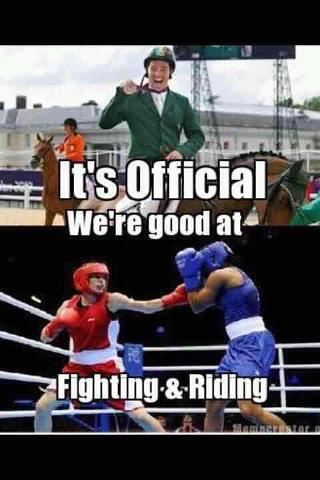
But it would seem to the untrained eye of someone like myself that we as a nation, and others as well, succeed at events in which we are well prepared and where the organisation in charge has a single-minded determination that its participants improve and win at (nearly) any cost (am I pointing out the obvious?). I think it is safe to say that the likes of the GAA, IRFU, the horse-racing community and the IABA (Irish Amateur Boxing Association) have proved over the years that they are willing to push their participants to the edge and to constantly improve on where they were. Some of these organisations receive a huge amount of attention and consequently a lot of funding from central government, North and South, to improve their facilities and increase participation, often to the detriment of other organisations. Point (iii) above is then usually wheeled out by competitor organisations But the problem I have with this is that it is an exceedingly negative point of view, one that borders on self-defeatist and I would not imagine that anyone would want to be part of an organisation with this kind of culture at its heart as it doesn’t exactly inspire one to go higher, faster or stronger but to wallow in self-pity instead.
Sammy on the Michael Conlon thread did note how important funding is; this I cannot disagree with. An athlete without proper funding is not going to be as competitive as they could be. Organisations such as the Irish Olympic Committee, Swimming Ireland or Basketball Ireland may be right in complaining that they are stuck in something of a vicious circle; they cannot attract more children to their disciplines as they lack the facilities, and because they lack numbers it means that Central Government will not throw money at disciplines which are seen as fringe events compared with the larger sporting associations. How do these organisations break this cycle to get more funding and participants? How do they also increase the standard of the competitors?
For me, funding an organisation that has not proven its professionalism is a non-starter (the FAI and IFA are prime examples of throwing good money after bad). Organisations may complain that others are poaching their best players (not in the North South eligibility sense btw), or that they have better facilities, and they often do (point (iv)), however, these organisations have often proven that they are willing to fight dirty(ish) and to the bitter end to get what they want. Is this not what we want in our competitors? I find it somewhat ironic that on a field of sport we are encouraged to give it our all, but in sports funding organisations seem to throw in the towel when faced with a larger competitor.
Our sportswomen and men are single-minded, determined and a credit to us all. They know they need to go above and beyond to try and succeed. I believe for us to improve our standard of competitors in what are fringe events at the moment those running these organisations really need to fight dirty 4 years at a time, not just every 4 years.
I know this is a somewhat lengthy post, but to illustrate a point, here’s a link showing what Ireland’s true queen has been doing to prepare (in this instance for the World Championships last year). Facilities are incredibly important, but organisational determination and professionalism is just as, if not more important.
http://www.youtube.com/watch?v=m4vY8VuMLss

 Keeping An Eye On the Czar of Russia